Showing posts with label Food Safety. Show all posts

17 September 2026

FOOD SAFETY AWARENESS HAS BECOME SECOND NATURE TO ME

After finishing my inspection work in the morning, I had my meal replacement drink and drove to Semporna.  Along the way, I suddenly noticed a traffic police officer hiding behind a tree, checking the speed of passing vehicles.  I looked at the display - 100 km/h.  My heart sank immediately.  I kept thinking about the possible bad outcome and wished I had Stephen Chow's special power: “You can't see me… You can't see me…” 😂  From that point onwards, I carefully kept my speed below 90 km/h.  As a result, I arrived at the small jetty in Semporna about half an hour later than expected.


When the boat left the jetty and entered the open sea, we soon encountered some small waves.  It was nothing compared to the frightening sea conditions I had experienced before, but it was enough to make the passengers nervous.  A few passengers could not help making small cries.  At one point, the captain stopped the boat to adjust its balance and asked some passengers to change their seats.  It was only when we were about 10 minutes away from the resort that the boat gradually became stable again.  When we arrived, everyone finally relaxed.


After arriving at the resort, I discovered a serious problem.  There was no internet.  The person in charge gave me several WiFi passwords.  After lunch, I tried them one by one.  Finally, one of them worked.  At that moment, I was truly relieved.  I quickly started my remote work and carefully used the WiFi to avoid losing the connection.  After finishing my work, I could finally relax and enjoy the resort.  I looked at the food prepared for the guests.  The hot food was placed on food warmers.  The moment I saw the food warmers, one word came into my mind: temperature. 


Whenever I see cooked food, I naturally wonder:  What is the temperature of the food? How long has it been at that temperature?  If cooked food is not kept at a safe hot-holding temperature, its temperature may slowly decrease. When food stays for a long time in a temperature range where bacteria can grow easily, the food safety risk increases.  This is what we often discuss in the Food Handler Training Course — The Temperature Danger Zone.  Each dish also had its own serving spoon or tong for guests to take food onto their plates.  I noticed that when the food was replenished, the food handlers did not simply pour the newly cooked food into the old tray.  Instead, they removed the old tray first and replaced it with a new one.  The amount of food in each tray was also just right.


I also liked the way they arranged the plates, forks, spoons, knives and cups.  Everything was arranged neatly.  Everything was clean, dry and in good condition.  I happily took a plate and started choosing my food.  I took a small amount of rice, followed by some meat, seafood and vegetables.  A little of everything was enough. If I ate too much, I would become full too quickly. 😂 After getting my food, I found a table near the food area, put down my plate and went to get a drink.  When I finished eating and left the table to get some pudding, ice cream and fruit, the staff cleared away my used dishes.  The tables always looked clean.  Every time I ate at the resort, I ate until I was full.  I was very satisfied.


This time, I was not in such a hurry at the resort.  In the afternoon, I could rest in my room, do some remote work and wait for dinner.  Time passed quickly.  Soon, it was almost time for dinner.  Before dinner, I went to the training room to set up my laptop, projector and training materials.  I also arranged all the training documents for the participants.  After enjoying a good dinner, I returned to the training room.  I was thankful that the client had arranged the training room near the office and also near my room.  Best of all, the room had air-conditioning.  That made things much better.  I could enjoy teaching that night.  I arrived early and waited for the participants.  Actually, I was a little nervous as in the afternoon, the staff had told me that the participants were managers and supervisors from different departments.  I started thinking:  How should I conduct this training?


At around 8 p.m., participants started arriving.  Everyone came into the room.  I politely invited them to take their seats, explained how the training would be conducted and introduced myself.  Then, the class began.  I used everything I could to engage the participants.  I talked with them, designed classroom activities, asked questions and included short tests during the training.  Although I was a little tired, everyone was very cooperative.  The course ended on time, and everyone could return to their rooms for a good rest.


The next morning, while checking the test papers, I discovered that one participant had not completed all the questions.  I took a photo as evidence and sent it to the person in charge.  I requested the participant to meet me at the meeting room at 9 a.m. to complete the remaining questions.  After giving the instruction, I went to enjoy my breakfast.


I did not eat as much as I had eaten quite a lot at dinner, so I wanted something lighter.  There was no porridge, so I simply had a piece of bread, a small amount of noodles and some eggs, together with a cup of coffee.  After breakfast, I returned to the meeting room.  The participant who had not completed the test arrived.  He looked a little embarrassed and quickly explained why he had not completed the questions.  I understood.  Perhaps he saw everyone else finishing the test and decided to hurry through his answers and submit the paper too.  Maybe he thought he could “get away with it.” 


Unfortunately for him, he met me.  I have a habit that is not easy to change:  If something is not completed, I will not let it go.  He had to do it again.  I smiled, took out his answer sheet and asked him to sit down and answer the questions properly.  He finished in less than three minutes.  He thanked me, and we said goodbye before he returned to work.  I then started applying for the certificate numbers and preparing the invoices for the participants.


After finishing everything, I leaned back on the sofa and took a short rest while waiting for the boat to return to the jetty.  The sea was calm on the way back.  I could hardly feel the waves.  I could not use the internet on the boat, but shortly after reaching the jetty, I was able to connect again.  I collected my car and drove straight home.  After arriving home, I still had enough time to print the certificates.  Then I drove to the client's company at town and delivered the certificates.


During this trip, what I noticed at the resort were the small details in the restaurant:  the temperature of the food, the cleanliness of the utensils, the neat arrangement, and the way the food handlers handled the food.  For someone who has been involved in food safety training for many years, these details naturally catch my eyes and enter my mind.  Perhaps this is what it means when we say:  Food safety awareness has become second nature to me.  It is not knowledge that appears only when I am conducting a training course.  It has become a natural part of my everyday life, even when I simply sit down and enjoy a meal.


This business trip went very smoothly.  The client was also very cooperative.  I deeply felt that a client's trust is built on honesty, taking work seriously, good preparation and the ability to handle situations flexibly.  I could also see how seriously the client took the Food Handler Training for their employees.  For such a serious and committed client, I am more than happy to provide my service.

22 January 2026

HIGH-RISK FOOD PREPARATION AREAS AND KITCHENS: WHAT EMPLOYEES SEE BUT OWNERS OFTEN MISS

A nicely decorated and cozy food premise, attractive packaging, delicious food, and friendly service all create a great first impression for customers. These are the things that owners carefully design and proudly present. Customers leave with a pleasant dining or purchasing experience.  However, what often goes unnoticed is the off-stage working environment—the food preparation area.

Food handlers experience this environment every day. They are the ones dealing with pressure, tight timelines, equipment limitations, and hygiene challenges during daily operations. Sometimes, managers may feel that food handlers are careless or not serious about their work. That may be true in some cases—but not always. Very often, there are underlying reasons why food handlers act differently or struggle to fully comply with company policies.

What owners often see is the dining or display area.
What employees see is risk quietly building up, day by day.


Busy Working Environment

The food preparation area is the production center of any food business. When there is a large number of complex orders, the working atmosphere quickly becomes tense. Food handlers must prepare products according to order specifications while ensuring hygiene and food safety.  In a busy kitchen, food handlers may start to “skip” certain hygiene steps in order to work faster. New food handlers, especially those with limited food safety knowledge, may believe that these shortcuts are acceptable because “everyone does it.”  This is exactly when cross-contamination risks begin to appear.

Common examples include:

  1. Skipping handwashing after using the toilet
  2. Using the same equipment for different food groups
  3. Continuing to use utensils or equipment with visible cracks or crevices
  4. Overcrowding all types of food in one refrigerator
  5. Allowing the food preparation area to become disorganized and poorly maintained

In a fast-paced working environment, these practices may seem normal. Unfortunately, they are serious food safety hazards. Very often, food handlers may not realize the risk until an inspection is conducted by authorities. By the time food business owners become aware of the situation, it may already be too late.


Equipment Condition and Usage

Food handlers rely heavily on equipment and utensils to process food. When equipment is clean and in good condition, food safety risks are significantly reduced. However, damaged equipment—such as torn baskets, corroded surfaces, cracked containers, or rough chopping boards—can trap food debris and dirt that are difficult to remove.  When such equipment continues to be used, bacteria can easily transfer to food, increasing the risk of contamination. This is why food business owners must regularly inspect equipment conditions and replace damaged items promptly.

Refrigerators and chillers are especially critical. Temperature control is the key concern. If the temperature rises above acceptable levels—for example, above 4°C—food safety can no longer be assured. Repairs may involve costs, but ignoring the problem can lead to unpredictable losses, including food spoilage, customer complaints, or even forced closure by authorities.


Food Premise Maintenance

After years of operation, food premises—especially food preparation areas—often develop issues such as cracks, crevices, holes, or rough surfaces. Employees usually notice these problems first. However, many choose to ignore them because they have become “used to it,” or because they believe management is unwilling to spend money on repairs.  When maintenance is repeatedly ignored, food scraps accumulate and pests find suitable hiding places. Over time, this creates a serious contamination risk that may only be discovered during inspections or audits.


Poor Personal Hygiene

Food business owners send food handlers to attend Food Handling Courses, and they understand the importance of personal hygiene. However, the real challenge appears during daily operations.  If a senior food handler suffers from food poisoning or flu, will the owner allow sick leave—or insist that the staff continue working until the end of operations? Even one sick food handler can easily contaminate food and cause foodborne illness among customers.  Personal hygiene must never be compromised.  I still remember implementing strict attire regulations in a food processing facility. All workers, office staff, and even visitors were required to wear proper attire before entering the processing area. Visitors had to register and comply with hygiene requirements. There were no exceptions. This discipline was something I remain proud of. During my service period, no major food hygiene incidents occurred in that company.


Listening to the Ground Reality

Employees understand the condition of the food preparation area better than anyone else. When food business owners take the time to listen to staff and understand on-the-ground challenges, they receive valuable insights.  If action is taken early, food safety standards can be maintained. If not, owners may only realise the true situation during inspections or audits—when options are limited to paying penalties or facing temporary closure of up to 14 days.

High-risk kitchens and food preparation areas are rarely the result of one big mistake. They are usually the outcome of many small, ignored issues—issues that employees see every day, but owners often miss.


#FoodSafety #KitchenManagement #RestaurantBusiness #FoodHandlers #HighRiskKitchen

15 January 2026

PREVENTING CROSS-CONTAMINATION: SIMPLE STEPS MANY KITCHENS OVERLOOK

Cross-contamination is one of the most common food safety risks—and also one of the most misunderstood. In many food premises, food handlers rely on habits, assumptions, or past experience instead of clear food safety principles. As a result, cross-contamination in commercial kitchens often happens quietly and goes unnoticed.  These risks are usually invisible to customers, inspectors, and even business owners—until a customer complaint, a food poisoning incident, or a failed inspection occurs. So how can food businesses prevent cross-contamination in the simplest and most practical way, especially in a busy kitchen environment?


Personal Hygiene

Poor personal hygiene is one of the most common causes of cross-contamination.  Imagine a food handler who wears dirty clothing, does not wear a head cover, wears short pants and slippers, has long fingernails, or is experiencing flu or mild food poisoning—but still reports to work. During food preparation and handling, there are countless opportunities for bacteria and dirt to transfer from the body to the food.  For example, Staphylococcus aureus from hair, skin, or hands can contaminate food and produce toxins that remain even after cooking. Once toxins are formed, they cannot be destroyed by heat. This is why food handler personal hygiene is not optional—it is a critical food safety control.  Food handlers must maintain proper hygiene every time they handle food, not only during inspections but as part of their daily routine.


Equipment Usage

Damaged or inappropriate equipment can easily cause cross-contamination risks.  Corroded frying pans, broken baskets, cracked containers, or wooden chopping boards can trap food debris and moisture. These conditions allow bacteria to multiply rapidly.  When food handlers continue using broken or poorly maintained equipment, bacteria can be transferred directly onto food. Therefore, food business owners should regularly inspect equipment condition and replace damaged items promptly.  In addition, food handlers should understand proper equipment usage for different types of food—such as high-risk, medium-risk, and low-risk foods. Many commercial kitchens use color-coded chopping boards or baskets to separate food types. When used correctly, this simple system is highly effective in preventing cross-contamination.


Food Handling Practices

Cross-contamination is most likely to occur when different types of food are prepared in the same area. High-risk foods, especially raw foods, naturally carry higher levels of bacteria and can easily contaminate other foods.  Food handlers must understand the importance of separating raw and cooked food, both during preparation and storage. Ideally, different foods should be processed in separate areas and stored at appropriate temperatures.  When raw food and ready-to-eat food must be stored in the same refrigerator, food handlers must arrange them properly so that raw food cannot drip, spill, or contaminate cooked or ready-to-eat food. Correct food handling practices are essential to maintain food safety and food quality.


Avoiding cross-contamination does not start with stricter rules or complicated procedures. It starts with people.  Cross-contamination is rarely caused by one major mistake. More often, it is the result of many small, unnoticed decisions made during daily operations—especially during busy hours. When food handlers are trained to recognize these risks early, they are not just protecting food. They are protecting customers, business reputation, and long-term sustainability.

08 January 2026

CAN FOOD SAFETY TRAINING REALLY REDUCE CUSTOMER COMPLAINTS? **THE ANSWER MAY SURPRISE BUSINESS OWNERS**

When was the last time you received a customer complaint? Was it about service quality, staff attitude, or simply that “the food doesn’t taste as good as before”? If we look at it positively, complaints are valuable feedback. They tell us where customers feel disappointed. However, when the same complaints keep recurring, it may be a signal that something deeper needs attention—perhaps your team’s competency in handling food.  Customers are not Health Inspectors. They will not comment on temperature control, cross-contamination, or hygiene procedures. But very often, their complaints are symptoms of food safety issues that happen behind the kitchen door.


Food Contamination Prevention

Nothing shocks customers more than discovering foreign matter—especially pests—in the food they ordered.  Some may complain directly to the business owner, while others choose to upload photos or videos to social media. In such cases, the damage goes beyond one complaint; it affects the reputation of the entire business.  Before food handlers are allowed to work, proper training equips them with basic knowledge on contamination risks and hygiene requirements. Trained food handlers understand their responsibility to keep food safe.  For food business owners, trained staff also make daily monitoring much easier. On the other hand, untrained food handlers may unknowingly create hazards simply because they do not recognize the risks involved.


When Food Starts to Taste “Weird”

Customers may not always complain openly. Sometimes, they simply do not return.  When food tastes different from before—or has an unusual texture—it is often not a recipe issue. Common causes include:

  • Food kept at room temperature for too long
  • Incorrect storage temperatures
  • Frequent in-and-out handling of food from refrigerators 

Under such conditions, bacteria begin to grow once food temperatures rise above 5°C. These bacteria break down the food proteins and fats, resulting in unpleasant taste and texture changes.  In Food Handler Training (FHC), food handlers learn the correct principles of food storage and temperature control. When these principles are applied consistently, food quality remains stable—and customer complaints naturally reduce.


Making the Right Decisions Starts with Knowledge

Some customers are very sensitive to food quality. This is especially true for seafood, where freshness is immediately noticeable—particularly to customers from the seafood industry.  If staff lack the knowledge to identify good-quality raw food, poor ingredient selection can easily lead to disappointing food quality and customer complaints.  During training, food handlers learn the fundamentals of raw food selection. When food handlers truly understand these principles, they gain confidence to make the right decisions.  For example, when assigned to purchase raw food, trained staff can recognize when food is not fresh and take responsibility to reject it—protecting both food quality and the business’s reputation.


So, Can Food Safety Training Really Reduce Customer Complaints?

Food Handler Training is not just a regulatory requirement. It is a foundation that ensures food is handled safely, stored correctly, and prepared with consistency.

While customers may complain about taste, quality, or unpleasant discoveries, many of these issues trace back to basic food handling practices.  When staff are trained, aware, and confident in making correct decisions, fewer mistakes occur—and fewer complaints follow.


The surprising truth is this:

Food safety training does not just protect you from inspections—it quietly protects your business from losing customers.

01 January 2026

WHY POOR COMMUNICATION IS A HIDDEN RISK IN FOOD SAFETY?

Food safety in a food premise is never a one-person responsibility. It is a teamwork effort that relies heavily on clear and effective communication.

Imagine this: the procurement team delivers raw materials without inspection, assuming the supplier has already checked them; QC personnel fail to clearly explain hygiene requirements to food handlers; kitchen staff prepare the wrong dish because an order was misunderstood—causing a serious food allergy incident.
The consequences can be far more severe than most people expect.


No Communication

When food handlers do not communicate during operations, and everyone assumes that others “know what to do,” misunderstandings and costly mistakes become inevitable.  New food handlers, when not clearly briefed on their roles and responsibilities, often work based on their own assumptions or imitate what they see others doing. This can be dangerous.  Years ago, when I was working as a QA Manager in a seafood factory, we decided to conduct pest control internally. I selected disciplined workers, briefed them on chemical spraying procedures, and believed they understood the task well.  Weeks later, a customer’s representative noticed a worker spraying chemicals at the receiving bay—while raw materials were still present. That moment made me realize a critical lesson: what seems like “common sense” to management is not always understood or taken seriously on the ground.  From that experience, I learned that communication must be clear, repeated, and followed up with supervision. Assumptions are one of the biggest hidden risks in food safety.


Miscommunication

Miscommunication happens when instructions are given, but interpreted differently.

During my early career as a QC in another seafood factory, I was once tasked to oversee the pasteurization process when my supervisor was unwell. When an unexpected issue arose, I made a decision based on my understanding of the process. Unfortunately, that decision resulted in the entire batch failing QC checks and requiring rework.  That incident taught me that food safety is not just about following instructions, but truly understanding the theory behind each step. Leaders and supervisors must continuously communicate, explain, and confirm understanding to ensure food safety is never compromised.


Inadequate Communication

Limited or unclear communication can lead food handlers to unknowingly create food hazards.  In restaurants, a wrongly taken order by a service staff can result in the kitchen preparing the wrong dish—posing serious allergy risks to customers.

Similarly, when SOPs are created but not properly explained, food handlers may misunderstand instructions. For example, if an SOP states that gloves must be worn during food handling, but leaders fail to explain when to change them and what shouldn’t they touch after wearing gloves, workers may wear the same gloves while handling everything—even when they are torn or contaminated.  Written procedures alone are not enough. Communication must ensure correct interpretation and application.


Forgetting Proper Food Handling During Rush Hours

During peak hours, communication often breaks down.  Food operations involve multiple ingredients, tools, equipment, and time-sensitive tasks. When food handlers do not communicate clearly under pressure, hazards are easily overlooked. Many staffs may not even realize that a risk exists at that moment.  This is why inspections and audits often discover multiple non-compliances


Lack of Feedback

A lack of feedback can allow food safety hazards to go unnoticed.  I once visited a small food stall for a quick meal and noticed a fly about to fly into a opened food display cabinet. Out of professional instinct, I pointed it out to the staff. She was shocked and immediately chase the fly away.  Had no one spoken up, the food would likely to be contaminated.


Food safety can only be maintained when effective communication is in place. Clear instructions, continuous reminders, supervision, and feedback ensure that food handlers operate in line with company policies and SOPs.  As we step into the new year, let us remember that good communication is not just about teamwork—it is a critical food safety control measure.


Wishing you a safe, successful, and food-safe New Year.
Happy New Year 2026! 🎉

29 April 2025

🧼🔥 HOW ONE CATERING BUSINESS BOOSTED ITS REPUTATION WITH FOOD SAFETY COURSE – YOU CAN TOO!

A growing catering business had everything going for them: skilled chefs, creative menus, and steady bookings. But then came a game-changing moment — a corporate client asked for proof of food safety training. That’s when they realized they were missing a critical piece of the puzzle: formal certification.

To stay competitive and build trust, the team enrolled in the [Food Safety and Hygiene in the Catering Industry] online course.

What started as a compliance task quickly turned into a valuable learning experience.
They learned about:

  • 🍲 Food contamination and spoilage — causes, prevention, and control methods
  • 🤢 Food-borne illnesses — common sources and how to avoid them
  • 🧤 Responsibilities of every food handler — what every team member must know

With this knowledge, their confidence — and their client satisfaction — skyrocketed. Today, food safety is a core part of their brand promise.

And here’s the best part:
If your team has already taken the Food Handlers Training Course, this course is the perfect refresher and booster. It deepens their understanding of food safety and hygiene, with engaging video clips that make learning enjoyable.

✅ Plus, there’s a self-assessment at the end!
I scored 84% on mine — how about you? Drop your score in the comments!

🎓 The course is free to study, and you can choose to purchase a certificate if you need one for job applications or business licensing.


📌 Ready to boost your team’s professionalism and credibility?
👉 Click Alison
Search: Food Safety and Hygiene in the Catering Industry

🚀 Take the course for free on Alison today — and let your reputation speak for itself.


28 May 2020

PAH at food

PAH (Polycyclic aromatic hydrocarbon) is a pollutants resulted from incomplete combustion.  It is also excreted when cooking at high temperature on food with high fats.

This chemical is useful in industrial production but not in food. PAH is a carcinogenic to human by binding to cellular proteins and DNA, resulting cell damage which lead to mutations, tumour and finally cancer.  PAH also reduce the immunity function of the body.     

Factors that effects PAH contains in food are cooking method, burning temperature, smoking process, smoking stage, lipid contents, environment contamination and so on. Food that contain PAH has high level of fats that is grilled, smoked such as sate, meat, barbecues chicken, fish or meat. For instance, scientist discovered smoke fish and meat contains 200 microgram / kg of PAH, barbecued meat contain 130 microgram / kg, charcoal grilled on duck breast steaks without skin had 320 mikrogram / kg and so on. 

To reduce the PAH contents while preparing food, we could

1. Avoid barbecue directly on fire. Use wrappings such as banana leaves of aluminium foil while barbecue or using quarry.

2. Cook slowly, such as adjust small quantity or burning.

3. Throw / reduce fats in the food before barbecue

It is not to say that we should not consume high temperature cooking of food but just to reduce the frequency of consumption. With that we could have a better diet, for us and our family.

Credit: 

1. Sir Sazly Tulih
2. Health Education Division, Ministry of Health Malaysia
3. Science Direct

23 May 2020

Fungus in food - do not let it take your life!

Fungus is microscopic microorganism that can grow in food. Most fungus is hazardous as it will produce mycotoxin, resulting food poisoning.

"Myco" means fungus and "toxin" means poison. It is a metabolit produced by hazardous fungus, such as Aflatoxin. Aflatoxin is a mycotoxin group that is form naturally from particular fungus such as Aspergillus flavus and Aspergillus parasiticus.

There are a few conditions that causing food contaminated with Aflatoxin:

1. Food that exposed to high environment moisture, in a long time.
2. Food that is stored in pile, without good ventilation.

What are the food that potentially contaminated with Aflatoxin?

1. Beans - groundnuts, pistachio, peanut butter, almond soybean, peanut, sunflower, cotton seed, walnut, coconut and Brazil nut.
2. Cereals - Corn, rice, wheat, soybean oil, corn oil, sunflower oil and sorghum
3. Spices - Chili, black pepper, turmeric, ginger, coriander
4. milk of animals that are fed with contaminated feed, in the form of aflatoxin M1.

Exposure to Aflatoxin at a higher dosage and for a long time could lead to Aflatoxicosis (which could be life threatening) that cause liver cancer. Knowing the seriousness of Aflatoxin contamination, we should learn to handle our food in order to avoid it. below are the advises from the experts -

1. Keep food in a dry place and hermetic, according to the storage instruction stated at label. make sure the store in inn good ventilation and with low humidity.
2. Choose good quality beans or cereals carefully while purchasing.
3. Avoid taking food which has the signs of spoilage such as fungus growth or physically changed on food.
4. Threw away food that is contaminated with fungus. Even when fungus is removed, mycotoxin would be still remained in the contaminated food. Thus, make sure the contaminated food is not to be used to process / prepare food.

Contaminated food not only resulting food poisoning but also could be fatal. As a responsible food handler, we should take note on this matter and do any possible practice to avoid it.

Credit: 

1. Sir Sazly Tulih
2. World Health Organization
3. National Center for Biotechnology Information
4. Science Direct

21 May 2020

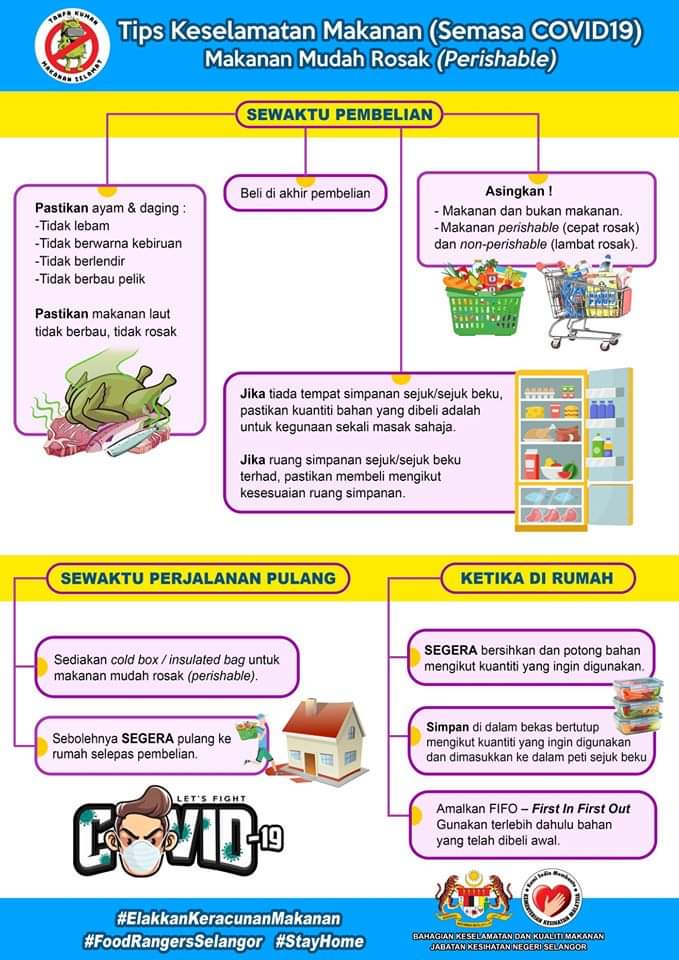
Handling of perishable food during MCO


Does MCO changed your lifestyle and eating habits? Many of us store food or buy take away food in order to stay home longer or to reduce our exposure to the public.  While having such good practice during MCO, do bear in mind that the food should be handled properly, so that we do not worry about having food poisoning and adding hassle.

So we go out to the food store mostly alone, and now perhaps more than 1 family members together. In the food store, do select good quality of raw food, especially the high risk food like chicken, seafood, meat and so on.  Spoiled raw food will result high bacteria load on the food and perhaps contains toxins excreted by the bacteria.  The food is therefore not advisable to be consumed even to cook it thoroughly.  Thus, do select meats that is not swollen, not in blue colour, no slime, no broken  and no odour smell.  It is best to buy high risk food at the end of our purchasing (last item to buy). This is to shorten the exposure of the food to the air, without preservation (by ice).

No matter you are usually buying food for your family or otherwise, you will experience the way that the hypermarket or supermarket cashier pack all items when you are paying. You will notice that food and non-food will be packed separately. This is very important.  As non-food item might have some substance / liquid (of chemical) leaking / excreted and contaminate the food. Also, do separate perishable and non-perishable food to avoid cross contamination. For instance, fishes and vegetable. Perishable foods is best to be kept in a separate box, preferable a cooler box. After finish purchasing, do return to home as soon as possible.

Well, after purchasing perishable food, do clean the raw food and cut them in pieces, according to the needs of cooking. Keep the food into enclosed container and store the food into refrigerator to prolong the food’s shelf life. What if there is no refrigerator? Well, you have to buy the quantity that is enough for a day cooking and do frequent purchasing. And, make sure to buy the food quantity that is fit to be kept into the refrigerator. Not too pack until no ventilation in it.  Always practice FIFO to ensure every food is fresh (or at least good quality) when preparing food. Do check also expiry date for packaged food.

This practices applies to everybody including the food vendors, especially now that we are allowed to sell take away food only. So that customers always enjoy good and safe food.


Credit: Food Safety and Quality Division, Ministry of Health

19 May 2020

Acrylamide in food - Avoid it


If you likes fried food and frequently consumed it, here is the information that you can't missed. Scientist had discovered a chemical called Acrylamide, formed in starch food when it is cooked at a high temperature for a long time.


Acrylamide is a chemical. It is used for industrial for making papers, dyes, plastics, water treatment and so on. On 2002, scientist has discovered that Acrylamide formed from sugars and an amino acid (asparagine) if food is cooked for a high temperature at 120oC or above by frying, baking, roasting. For examples the food like french fries, banana chips, fried rice, fried noodles, toast, potato toast.

So far there is scientific proof showing animals having acrylamide induce cancer and on-going studies are to be expected. However, there are 3 recognized international institution determine Acrylamide as follow :

Looking into these information, we, as a consume should be more alert to avoid consuming food that might contains acrylamide. Here are some tips for us to practise in order to avoid acrylamide in our diet: 

  • 1.  Avoid cooking your foods until they are dark brown. Cook until the food turn to golden yellow colour is fine. 
  • 2.  Potatoes that have their skins on when they are cooked in the microwave or boiled tend to have lower levels of acrylamide.
  • 3.  Heat foods at the proper temperature and don’t overcook them. 
  • 4. Soak raw potato slices in water for 15 to 30 minutes before frying or roasting to reduce acrylamide formation during cooking. (Soaked potatoes should be drained and blotted dry before cooking to prevent splattering or fires.)
  • 5. Avoid storing potatoes in the refrigerator, which can result in increased acrylamide levels during cooking. 
  • 6. Follow instructions from the manufacturer (for the packaged product), to avoid overcooking.
With that we can help to take care everybody's health in cooking. Even if we cannot avoid 100% but we can reduce the exposure.  
  • .  

Credit: 

1. Food Safety and Quality Division, Ministry of Health
2. American cancer society
3. FDA US Food & Drug
4. International Food Information Council Foundation

12 May 2020

Educate our children in drinking packaged milk


Children need calcium for growth. We do encourage our children to drink more milk as it is a good source of calcium. However, we need to educate our children to differentiate good milk from the bad one, to avoid food poisoning to them.

Before drinking any drinks, children should SEE the physical appearance of the packing if it is in good condition. Do not drink the packaged milk if the packaging is tinted and damaged. After that, observe the expired date printed on the package if it is still safe to be consumed. Children may shake the milk to feel if there is "something" in the package.

Children can also SMELL the milk if it smell differently. If it had bad smell such as sting or sour, very apparently the milk had damaged. It could be contaminated either with a lot of bacteria (Biological contamination) or chemical (Chemical contamination). We must throw this damaged milk, avoid drinking it.

To confirm the milk is in fresh, suck / drink to the mouth and TASTE before swallow it. Taste the milk if it taste exactly like milk and not stale or sour. When the milk taste differently, it could be started to damaged.

IF children has food poisoning sign such as stomach ache, diarrhea, vomit, faint, nausea, we must inform teacher and the children's parent so that they can arrange to adjacent clinic or hospital for treatment.
Children's immune system is weaker than adults. So, we have to be more concern in milk quality self-check from the children, so that they can obtain essential nutrient safely.


Credit: Food Safety and Quality Division, Ministry of Health